
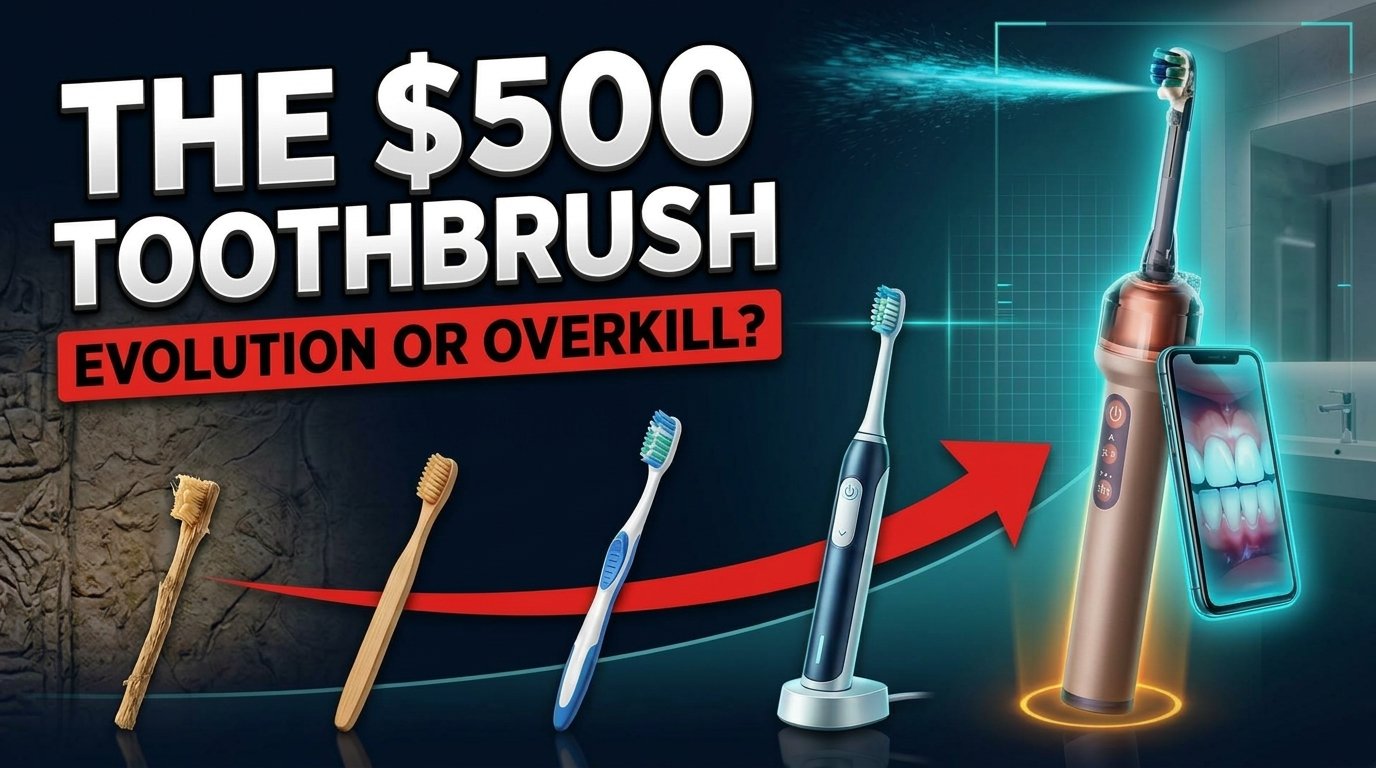
Dyson built a toothbrush with a camera, machine learning and a mouthwash jet that fires between your teeth. Early reviewers liked the clean. The launch is another story.
By Gene B. Geraissati, Founder & Tech Curator | Review roundup
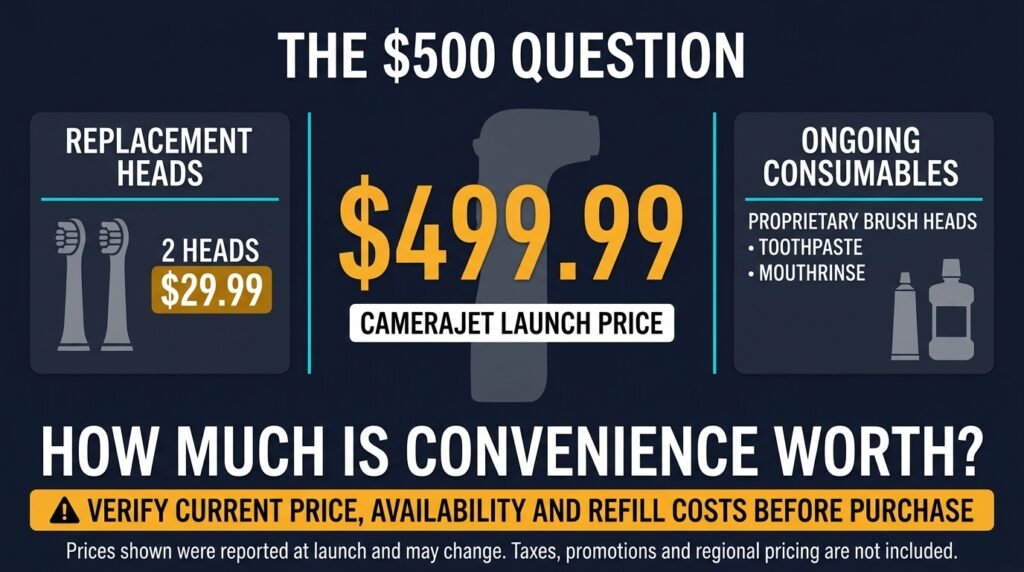
The $499.99 CameraJet is ambitious and, according to several early reviewers, capable of delivering a thorough clean. But its steep learning curve, recurring costs and a component issue affecting some early batches make it difficult to recommend right now.
Editorial disclosure: OTN did not test the Dyson CameraJet. This article analyzes Dyson’s published specifications and statement alongside independent hands-on reports. Product availability, pricing and the status of affected batches may change after publication.
Key takeaways
- The CameraJet combines sonic brushing, targeted liquid flossing and a live camera view in one device.
- Dyson lists a $499.99 launch price, a 10-day battery life and a substantial 230-gram handle.
- Hands-on reports praise the cleaning concept but describe a messy learning curve, bulk and high running costs.
- Dyson says a small number of early batches have a component issue and promises refunds for affected units. Waiting is the safer buying decision.
What the CameraJet actually does
The CameraJet is an electric toothbrush and oral irrigator built around a tiny camera. Dyson calls the system Gap Optical Targeting. The company says a 100,000-pixel macro camera scans 28 images per second, identifies gaps between teeth and triggers a conical burst of mouthrinse within 100 milliseconds.
That description sounds excessive until the purpose becomes clear. Instead of asking the user to aim a separate water flosser, the brush tries to find interdental spaces automatically while the user follows a normal brushing motion. The camera can also stream a live view to the MyDyson app, turning the brush into a basic dental endoscope.
Dyson says the machine-learning system was developed with 470,000 dental images and that the product runs 16 million lines of code. Those figures describe the scale of the engineering effort. They do not, by themselves, prove that the CameraJet produces better long-term oral-health outcomes than less expensive brushing and interdental-cleaning routines.
The design comes with practical compromises
The integrated jet needs a 12.5-milliliter tank in the handle and a refill dock with a 200-milliliter reservoir. The result is a 230-gram device, far heavier and bulkier than a conventional electric toothbrush. Dyson rates the battery for 10 days and includes a USB-C charging system, travel protection and replaceable RFID-equipped brush heads.
The dock refills the handle in about three seconds, according to Dyson. That is an elegant solution for a device that consumes mouthrinse during every combined brushing and flossing session. It also ties the experience to additional hardware and consumables. TechRadar listed replacement heads at $29.99 for a pack of two at launch and noted the ongoing cost of Dyson toothpaste and mouthrinse.
What hands-on reviewers liked
The strongest positive theme is that the core idea appears to work. TechRadar’s reviewer used the CameraJet for a week and reported that the brush and jet left her teeth and gums feeling fresh and clean. She also found the live camera feed clear and responsive. Stuff reached a similar conclusion after a week, describing meaningful changes in brushing habits and treating the guided experience as more than a novelty.
The camera is the feature that separates the CameraJet from premium smart brushes made by Oral-B, Philips and Oclean. Many competitors can track coverage or pressure. Dyson adds a direct view inside the mouth and uses that image stream to decide when to fire the jet. For buyers who dislike separate flossing, the promise is easy to understand: one device, one session and less manual aiming.
The learning curve is real
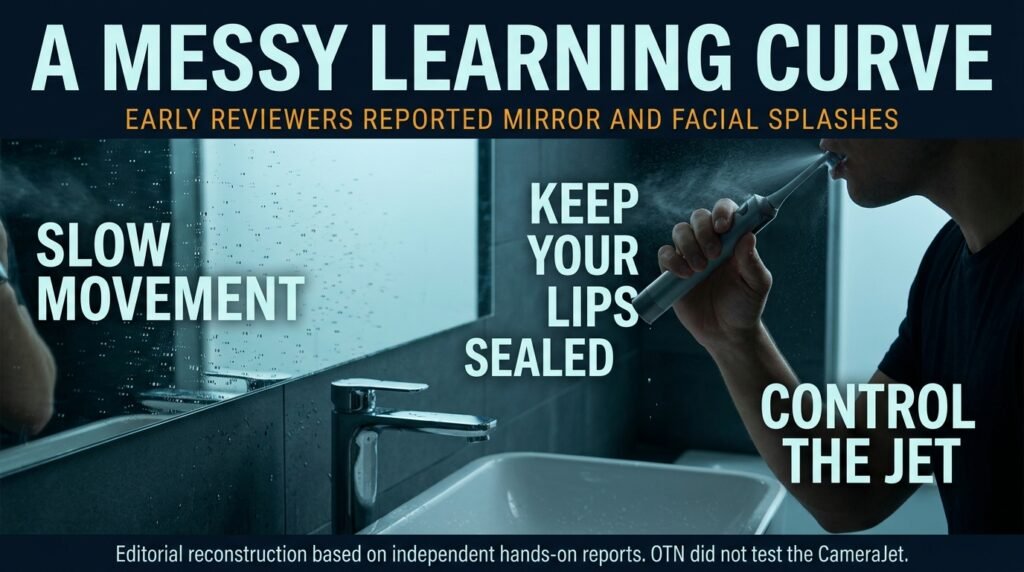
Positive reviews still describe a product that takes practice. TechRadar reported spraying a mirror and, on the first attempt, the reviewer’s forehead. Expert Reviews called the brush unusually messy and emphasized the patience required to learn the technique. A targeted jet is useful only when the user keeps the brush and lips in the right position.
The size matters too. A 230-gram handle carrying a camera, tank, pump, battery and motor is a very different object from a slim electric brush. The CameraJet may be technically cordless, but its dock, reservoir, proprietary heads and liquids make the full system less convenient for travel than the handle alone suggests.
The launch problem changes the verdict
On September 21, 2026, Dyson acknowledged that a small number of early batches had experienced a component issue. The company said it had isolated those batches, would support customers and would provide a full refund for impacted units. It also attributed shortages to strong global demand and said another wave of products should arrive within weeks.
Consumer Reports encountered a unit that would not run long enough to complete a brushing session and said it returned immediately to a regular toothbrush. Reports from multiple markets also described delayed orders, unavailable stock and early failures. These reports do not establish a failure rate, and Dyson has not published one. They do establish enough uncertainty to make a launch-day purchase hard to defend at $499.99.
What about privacy?
A Wi-Fi-connected camera used inside the mouth deserves a direct privacy explanation. Dyson says the camera operates only during live viewing or automatic jetting. The company also says images are not recorded or stored on the product or in the cloud and remain private to the user. OTN has not independently audited those claims.
The app can show cleaning guidance, coverage maps and personalized feedback. Buyers should still review the current privacy policy, app permissions and account requirements before enabling connected features, especially because software behavior can change after launch.
Does it replace flossing?
Dyson markets the jet as precision flossing, but buyers should distinguish a product claim from personal dental advice. The American Dental Association says interdental cleaning is an essential part of oral care and recognizes several types of cleaners, including floss, brushes and water flossers. It also notes that evidence for oral irrigators has historically been limited and inconsistent. A dentist can recommend the right method for an individual’s teeth, gums and dental work.
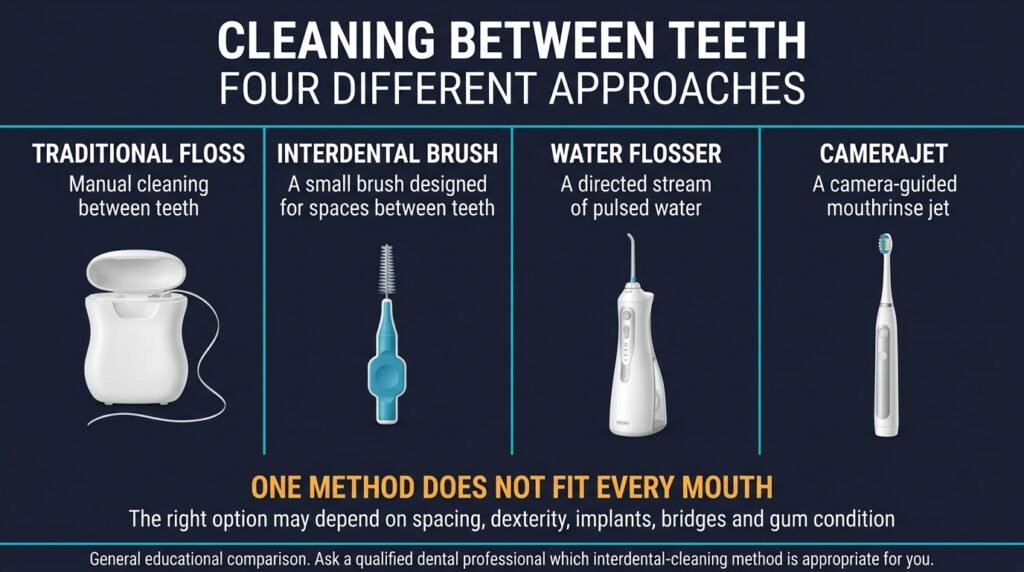
The CameraJet may make interdental cleaning easier for people who otherwise skip it. That behavioral benefit could matter more than the camera specification. It still does not make a universal replacement claim appropriate for every user.
Who should consider it
The CameraJet makes the most sense for an early adopter who values guided oral care, dislikes using a separate water flosser and accepts proprietary consumables. It also suits someone interested in seeing inside the mouth through the app and willing to learn a new technique.
Most buyers should wait. A conventional electric toothbrush plus floss, interdental brushes or a separate water flosser costs far less and avoids the uncertainty surrounding the first production batches. Waiting for stable availability, longer-term reliability reports and clearer clinical evidence is the rational choice.
OTN verdict: wait
The Dyson CameraJet is not a pointless gadget. Its camera has a defined job, the automatic jet addresses a real behavior problem and early reviewers found the cleaning experience promising. Dyson appears to have built a genuinely different oral-care device.
It is also a $499.99 first-generation product with a complicated routine and a launch affected by component problems. The technology is worth watching, but the first wave asks buyers to accept too much cost and uncertainty for a toothbrush they depend on twice a day.
Methodology
OTN reviewed Dyson’s launch materials, product specifications, MyDyson app information and its September 21, 2026 product update. We compared those claims with hands-on reporting from TechRadar, Stuff, Expert Reviews, The Irish Times and Consumer Reports, as well as TechRadar’s interview with Dyson chief engineer Jake Dyson, and consulted the American Dental Association’s guidance on interdental cleaning. OTN did not receive, purchase or test a CameraJet.
Frequently asked questions
How much does the Dyson CameraJet cost?
Dyson launched the CameraJet at $499.99 in the United States, £419.99 in the United Kingdom and AU$799 in Australia. Prices and availability may change.
Does the Dyson CameraJet record video inside your mouth?
Dyson says the camera provides a live view and supports automatic jetting but does not record or store images on the device or in the cloud. OTN has not independently verified the privacy implementation.
Should you buy the Dyson CameraJet now?
Most buyers should wait for stable inventory and longer-term reliability reports. Dyson has acknowledged a component issue in some early batches and offers refunds for affected units.
Sources
- Dyson – Introducing CameraJet (launch and technology)
- Dyson – CameraJet product update
- Dyson – CameraJet specifications
- Dyson – MyDyson app
- TechRadar – Dyson CameraJet review
- TechRadar – Interview with Jake Dyson
- Stuff – Hands-on after a week
- Expert Reviews – Dyson CameraJet hands-on
- The Irish Times – Dyson CameraJet review
- Consumer Reports – Dyson CameraJet first look
- American Dental Association – Floss and interdental cleaning
Images: OTN, AI-generated with Google Flow. They are editorial illustrations, not photographs of the product.
Editorial transparency: This article was drafted with generative AI under human editorial direction. On Tech Now is responsible for its final review, accuracy and publication.